
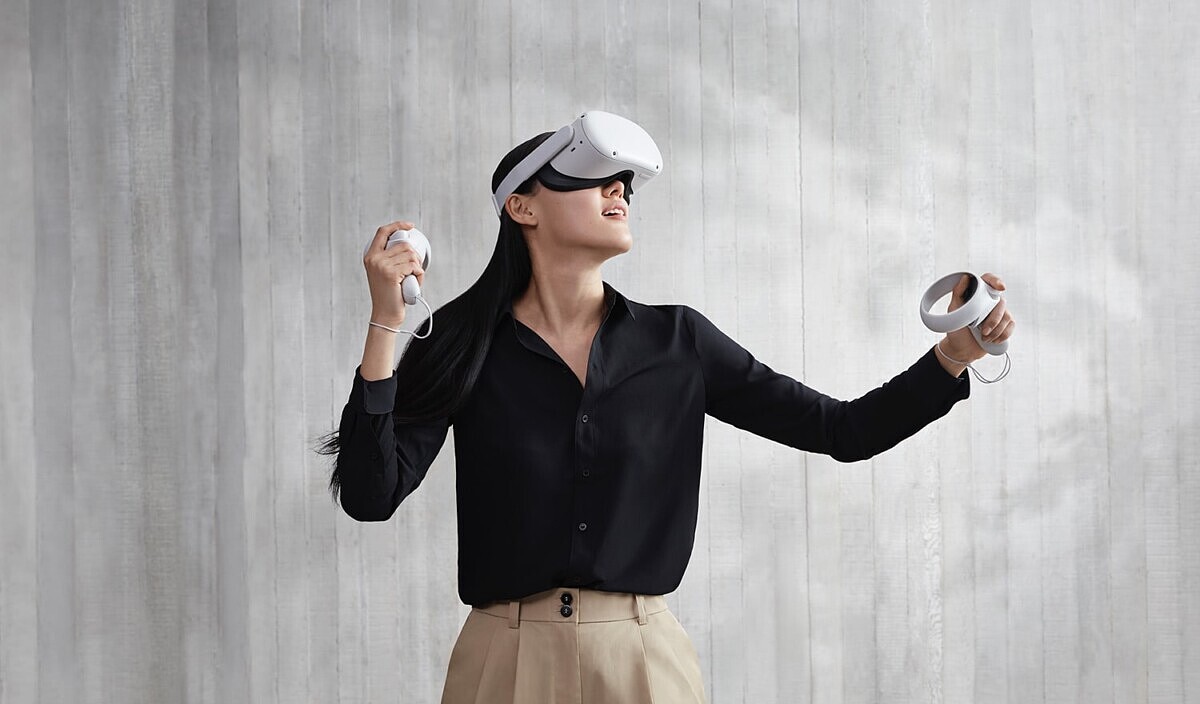
In September 2020, Facebook announced the Oculus Quest 2, the next generation of its all-in-one VR headset. The first Quest changed wireless VR: it brought new experiences to enthusiasts and new opportunities to developers, and it introduced immersive gaming to newcomers around the world. Quest 2 pushes this further with a redesigned headset, new Touch controllers and the highest-resolution display Oculus had made so far.
Quest 2 started at $299 USD, $100 less than the original Quest. Pre-orders opened on announcement day, and Quest 2 shipped on October 13, 2020.
Update (October 2026): Facebook has since renamed itself Meta, and the headset is now called Meta Quest 2. In September 2024, Meta announced that Quest 2 would be discontinued, and it introduced the Quest 3S as its new entry-level headset. This article describes Quest 2 as it was launched in 2020.
In this article
A Sharper and Faster Screen
The biggest change is the screen. It has a higher pixel density, 50% more pixels than the original Quest, and supports refresh rates up to 90Hz, much like the top smartphones of 2020. The picture inside the headset is noticeably sharper, crisper and smoother, matching the experience of Oculus’s PC-based Rift S headset.
Existing games from the Quest library benefit automatically. At launch they ran at a 72Hz refresh rate, and the full 90Hz was promised through a later software update.
Easier to Adjust and Wear
Adjusting the headset is simpler too. The head strap has two clips that you slide apart to tighten it, and the top strap uses Velcro. The lenses have three set positions for the interpupillary distance (IPD), the distance between your eyes. Oculus says 95% of people should find a position that is comfortable for them.
The headset is also slimmer and more than 10% lighter than the original Quest, so it is easier to carry and to wear.
Built for Next-Generation Gaming
The first Quest introduced the all-in-one design, powered by technologies like the Oculus Insight tracking system. Quest 2 takes a big step forward in processing power with the Qualcomm Snapdragon XR2 platform, which also offers better AI capabilities, and 6 GB of RAM.
The new display has 1832 x 1920 pixels per eye. With 50% more pixels than the original Quest, everything looks better, from multiplayer games and productivity apps to 360° videos.
The new Touch controllers are inspired by the original Touch design but offer better ergonomics, with the same intuitive controls that turn your hand gestures into movements in VR. Oculus also made controller tracking more efficient, so battery life is up to four times longer than with the original Quest’s Touch controllers.
Accessories and Audio
Quest 2 supports a new line of optional accessories that improve fit and comfort:
- Elite Strap with Battery: doubles the playtime and improves balance, made for long play sessions.
- Fit Pack: swappable facial interfaces for wider or narrower face shapes.
Stereo speakers are built into the side arms of the strap and produce immersive positional audio. If you prefer to be isolated, plug regular headphones or earbuds into the headphone socket on the side of the headset. With the built-in speakers, you can still hear a little of the real world while you play.
Specifications
- Screen: Fast-switch LCD, 1832 x 1920 per eye, up to 90Hz
- Processor: Qualcomm Snapdragon XR2
- RAM: 6 GB
- Storage: 64 or 256 GB
- Operating system: Quest software platform
- Connectivity: Wi-Fi 6, 3.5 mm headphone socket, USB-C with Oculus Link, stereo speakers, microphone
- Headset dimensions: 191.5 x 102 x 142.5 mm
- Headset weight: 503 g
- Controller dimensions: 90 x 120 mm
- Controller weight: 126 g (without battery)
Source: Introducing Oculus Quest 2, the Next Generation of All-in-One VR (Facebook’s official announcement, also published on the Oculus blog).