
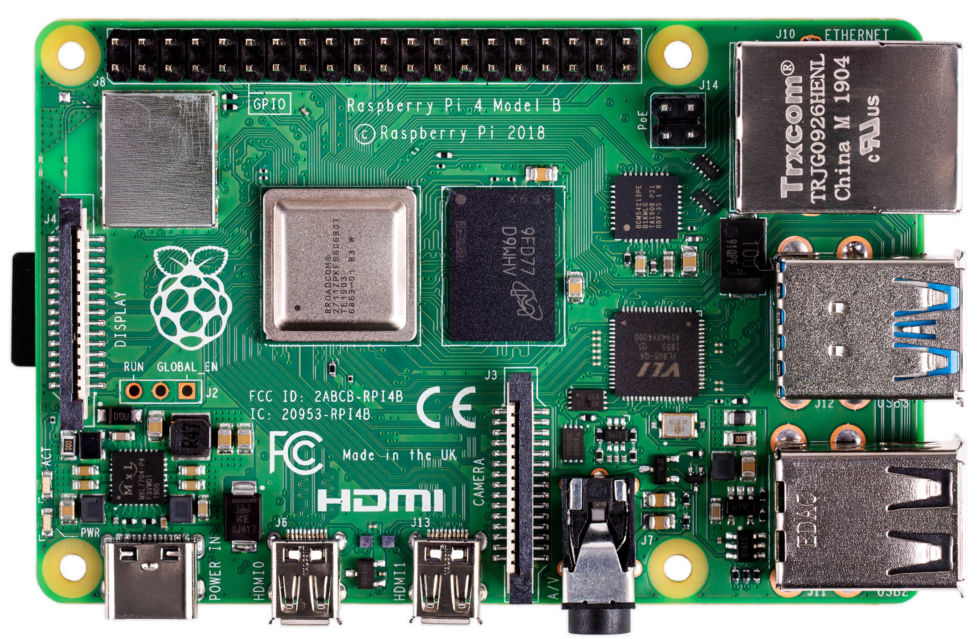
The next big Raspberry is here, with a lot more computing power and more options. On June 24, 2019, the Raspberry Pi Foundation launched the Raspberry Pi 4, a complete upgrade that touches nearly every part of the platform. Here is what is new, what it costs and what experts say about it.
Update (October 2026): This is our 2019 launch news. Since then, Raspberry Pi added an 8 GB Raspberry Pi 4 for $75 (May 2020), renamed Raspbian to Raspberry Pi OS (also May 2020), and released the faster Raspberry Pi 5 in October 2023. The prices below are the 2019 launch prices.
In this article
Price and memory options
Raspberry Pi 4 gives you a choice of three memory sizes:
- 1 GB RAM: $35, the classic Raspberry Pi price
- 2 GB RAM: $45
- 4 GB RAM: $55
All three versions went on sale on launch day. The foundation built more of the 2 GB version than the others and planned to adjust the mix over time to meet demand.
The credit-card-sized board is sold on its own, without any accessories. There is also a complete Desktop Kit for $120 with the 4 GB board, an official case and power supply, a keyboard and mouse, two HDMI cables, a microSD card with the operating system already installed and the official Beginner’s Guide. You still need your own monitor. See the official launch announcement for the full details.
PC-like performance for the first time
Version 4 delivers PC-like performance for the first time, while keeping the interfacing capabilities and “hackability” of the classic Raspberry Pi line. The new features make it the most powerful Raspberry Pi to date, according to Charles King, principal analyst at Pund-IT. It mostly targets hobbyists, the maker community and education, but the upgrade should open up new uses and new market opportunities for the platform.
“The enhanced performance and functions allow the platform to compete more effectively with PC-class chips, including Intel Atom and Celeron. It could open doors for Raspberry and Arm among vendors developing IoT devices that are looking for alternatives to x86,” King told LinuxInsider.
From hobby projects to the workplace
The new board and the next-generation software put Raspberry Pi in a position to grow beyond its mostly hobbyist and educational users and into the workplace. Although its main audience is education, Raspberry Pi has become more powerful over the years and a huge hit with the wider maker community, according to Simon Ritter, deputy CTO of Azul Systems.
“I’ve seen it used for pretty much everything you can think of, from robot control to maintaining a scoreboard for basketball to machine learning applications playing Minecraft,” he told LinuxInsider.
The big increase in power will make Raspberry Pi even more attractive to users. The 64-bit processor and up to 4 GB of RAM make it capable of really significant tasks, Ritter added.
“Adding two 4K displays, Gigabit Ethernet and USB 3 is incredible,” he said.
A strong platform for the Internet of Things
These new features could make the Raspberry Pi a good fit for the crowded field of Internet of Things (IoT) workloads. Some people already present the Pi as an effective platform for IoT development and deployments, noted Pund-IT’s King.
There are many open source operating systems designed for IoT workloads, such as Arm’s Mbed, Amazon’s FreeRTOS, Contiki and TinyOS. Microsoft’s Windows 10 IoT and Wind River VxWorks are not Linux distributions, but you cannot ignore them either, he added.
“There have been a number of other development boards produced, but none seems to have been as big a hit as the Raspberry Pi,” Azul’s Ritter said.
Raspberry Pi is in a performance class of its own, said Raspberry Pi co-founder Eben Upton. “We don’t believe there is anything out there in the same price/performance class as Raspberry Pi 4.”
Better performance and faster
The fourth-generation board is faster and more capable. It supports two screens and 4K resolution. According to the foundation, it delivers three times the processing power and four times the multimedia performance of its predecessor, the Raspberry Pi 3 Model B+.
The goal of the upgrade is to give most users a rich computing experience with balanced performance, at roughly one-tenth of the cost of a traditional desktop computer, Upton said.
“Raspberry Pi 4 is the first product we’ve produced that meets the performance level required to function as a general-purpose PC for the majority of users. It’s a good fit for users who want to browse the Web, edit documents or watch videos,” he told LinuxInsider.
Beyond use as a general-purpose PC, Upton expects the board to be widely used for media playback, such as set-top boxes, and for digital signage, industrial control and automation. In education, it is used both for teaching young people programming and for physical computing projects like robotics and weather stations.
Upton predicted that demand for Raspberry Pi will grow with this upgrade, because more performance is how the foundation grows its user base.
“Raspberry Pi 4 has triple the performance of its predecessor, so we hope to see an increase in adoption,” he said.
The way the Raspberry Pi developers pack so much computing power into such a small board without a fan, while keeping the low price, is phenomenal, noted Ritter.
“This will make it much easier for people to deploy existing Java applications straight onto these boards without code modification or recompilation,” he pointed out.
New Raspbian software
New Raspbian software was released together with the Pi 4. To support the new board, the developers shipped a heavily overhauled operating system based on the upcoming Debian 10 “Buster” release.
The move to Debian 10 Buster brings many technical improvements behind the scenes. It also brings a modernized user interface and updated applications, such as the Chromium 74 web browser.
Raspberry Pi 4 highlights
- A 1.5 GHz quad-core 64-bit Arm Cortex-A72 CPU (about 3× the performance)
- 1 GB, 2 GB or 4 GB of LPDDR4 SDRAM
- Full-throughput Gigabit Ethernet
- Dual-band 802.11ac wireless networking
- Bluetooth 5.0
- Dual monitor support, at resolutions up to 4K
- 4Kp60 hardware decoding of HEVC video
- Complete compatibility with earlier Raspberry Pi products
Watch the official launch video
Here is the official Raspberry Pi 4 launch video from the Raspberry Pi team:
The quotes from Charles King, Simon Ritter and Eben Upton were given to LinuxInsider.